
Closing Shift Roblox: How to Hide in Closets and When It Works
Hiding in a closet is Closing Shift's recommended response when Freddy, Bonnie or Chica is near. What the game actually says it does, the Foxy exception, and when it is safe to come out.
Quick answer
Hide in a closet when Freddy, Bonnie or Chica is near you. It is one of three defensive options the game advertises — alongside crawling through vents and barricading doors — and the thing the description says the animatronics kick in is the barricaded door, not the closet. Foxy is handled differently: keep your light pointed at its face. No closet instruction is attached to Foxy.
- The official description lists closet hiding, vent crawling and door barricading together, and its only breakability warning is attached to barricaded doors.
- Hiding is a way to slow an animatronic down, not a guaranteed shield — they hunt by rules the description does not spell out.
- If you hear singing, don't leave the room.
Closing Shift is the Roblox horror experience by DoggyTroug: the elevator seals shut behind you and a family restaurant that closed in 1974 is still being worked by Freddy, Bonnie, Chica, Foxy, Golden Freddy and Fredbear. Hiding in a closet is one of the short list of defenses the game itself advertises, so it is worth knowing what it covers, which animatronics it is recommended against, and what it does not promise before one of them is already standing in the room.
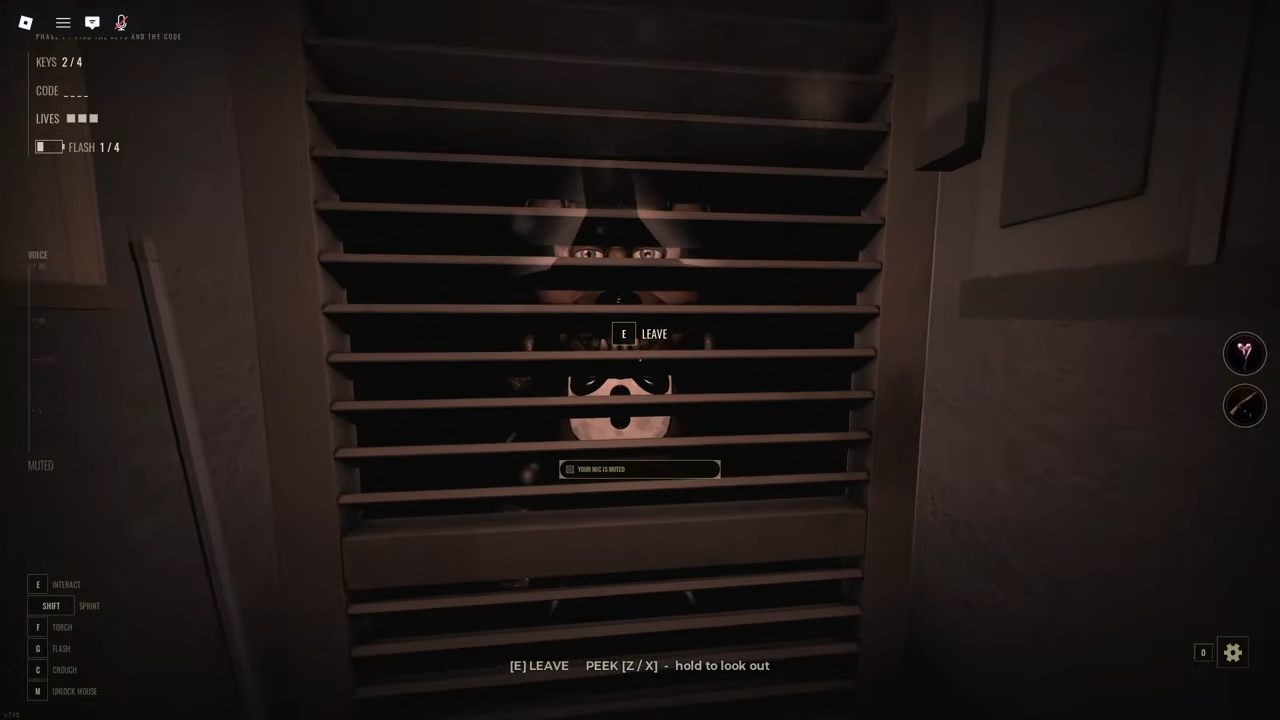
What hiding in a closet does
The game's own description puts hiding on a three-item defensive list: "Hide in closets, crawl the vents, barricade doors (they kick them in)." Read the parenthetical closely, because it is the only direct comparison the description makes between those options. The animatronics kick barricaded doors in. Nothing similar is said about closets or vents, and that is the strongest supported reason the closet is on the list at all: it is a defensive option the game advertises and does not describe as breakable.
The description stops there. It does not describe the interaction itself — no key, no prompt, no animation, and no statement about what an animatronic does when you are inside. So the accurate expectation is not "the closet protects me" but "the closet is a place to get out of the open and make the animatronic spend its time hunting instead of reaching me." Anything more specific than that — how quickly it loses track of you, or whether it can open the door — is not something the supplied material establishes.
When a closet is the recommended move
The third-party guide repeats the same sentence for Freddy, Bonnie and Chica — "Hunts by its own rules, which the description does not spell out. It can hear you over voice chat. Hide in a closet or crawl through the vents when it is near." — and answers Foxy differently, so who is coming near you decides which line applies:
| Animatronic | Action when it is near |
|---|---|
| Freddy, Bonnie or Chica | Hide in a closet or crawl through the vents. The closet is named first, and no condition is attached about which room you are in. |
| Foxy | Keep your light pointed at its face. No closet instruction is attached to Foxy. |
| Golden Freddy | Named in the description among the animatronics that hunt by their own rules; the supplied guidance gives no closet or light instruction for it. |
| Fredbear | Same as Golden Freddy — listed as hunting by its own rules, with no closet or light instruction supplied. |
Two things follow from that. The trigger is proximity: the guide tells you what to do when that animatronic is near you, not as a standing precaution for the whole night. And the closet is offered first, ahead of the vents.
This recommendation is a suggested response rather than a demonstrated interaction. The guide does not give controls or show a recorded outcome, and it is tied to the official description rather than to a test. Treat it as the reasonable default for those three, and keep in mind that their individual hunting rules are exactly the part the description leaves open — the Closing Shift animatronic behavior guide collects what is known about each of them.
Foxy is the exception
The same guide handles Foxy differently: "Keep your light pointed at its face to deal with it." There is no closet instruction attached to Foxy, and the official description carries the light-on-Foxy's-face tip as its own separate bullet, distinct from the hide-in-closets one.
So the closet advice in the supplied material is scoped to Freddy, Bonnie and Chica. When what is coming near you is Foxy, the action the sources give is the light, not the closet — and the description treats those as different answers, not two versions of the same one.
Hiding slows an animatronic down; it does not end the threat
The tips list on the same site groups the options into one behaviour: "Hide in closets, crawl through the vents, or barricade doors to slow down the animatronics, knowing that they kick doors in." Three details matter in that single sentence. The verb is slow down — not stop, not block, not escape. The door-kicking caveat is attached to the doors again, so the tips list agrees with the description about what actually breaks. And nothing in it claims that a closet ends a hunt permanently.
The practical consequence for your night is that a closet is borrowed time rather than a win condition. You go in to stop an animatronic from closing on you, and you come back out to keep working on the four keys and the four-digit code that call the elevator. If you are weighing the three options against each other, the vents guide and the barricading doors guide cover the other two.
Knowing when to come back out
The one timing rule the description gives that bears on leaving cover is: "If you hear singing, don't leave the room." Note the exact scope — the rule is about the sound, and about leaving the room while you can hear it. The description does not tie it to closet exits specifically, so it is not a closet mechanic; it is the condition under which moving is against the stated rule while you are waiting in one.
That makes the audio cue the deciding signal rather than a timer. The description also tells you to play with headphones so you can hear the restaurant, which is how that cue reaches you in the first place. Wait, listen, and step out once the singing has stopped rather than at a fixed moment — the stated rule is written around what you hear, not around how long you have been shut in.
Hiding is one lever in the survival loop
A closet answers exactly one situation: an animatronic is near. The rest of the supplied material widens the options around that moment.
- Voice chat. The animatronics listen to it, and the description says that if you say the right thing they may let you go — worth remembering when talking is an option while you wait. The voice chat guide covers that side of the game.
- The Puppet at the security desk. The description tells you to ask it for help, which is a route that does not involve going into a closet at all.
- The cameras. They are the supported way to see what is moving through the restaurant while you wait, and the description notes that the band still performs on them. The camera guide goes further.
- Headphones. Recommended so you can hear the restaurant, including the singing cue that governs when you move again.
Used together, those turn hiding from a reflex into a decision: what is nearby, what you do while it is nearby, and when you are allowed to move. For the night as a whole, the survival guide puts the closet in that wider context.
The honest summary is that the closet is an advertised defensive option, recommended specifically against Freddy, Bonnie and Chica, explicitly paired with a different answer for Foxy, and framed by the sources as something that slows animatronics down rather than as a safe room.
Related Guides
Foxy: Recognize and Counter
Recognize Foxy from his patrol voice lines and use your light as the stated answer.
Vents: Crawl to Dodge Hunters
Learn when crawling through ducts beats hiding or barricading and which hunters the vents avoid.
Survival Guide: Counter Each Encounter
Use closets, vents, barricades, Foxy's light rule and voice chat when an animatronic finds you.